

Grow Your SMM Panel: Metrics, Retention and Scaling
Launching is the easy part. This chapter shows how to measure what is working, keep customers coming back, add reseller revenue and scale without breaking your margins.
In this chapter
- The six numbers that tell you whether your SMM panel is healthy, and how to read them weekly.
- Retention tools that actually move repeat deposits: coupons, deposit bonuses, referrals, Telegram.
- How to open a reseller channel with the customer API and child panels.
- When to automate, when to hire staff and when a plan upgrade pays for itself.
- The growth traps that quietly kill panels, and how to avoid them.
This chapter assumes your panel is already live with services, payments and a storefront. If you are still before launch, go back to setup first. For finding your first customers, read how to get customers for an SMM panel on the smmfor.com blog — this chapter is about what happens after they arrive.
Growth starts with measurement
Most new panel owners judge their business by one number: today's revenue. That number swings with a single big customer and tells you almost nothing about whether the panel is getting healthier. Before you change prices, run promotions or buy ads, set up a simple weekly review of a handful of metrics.
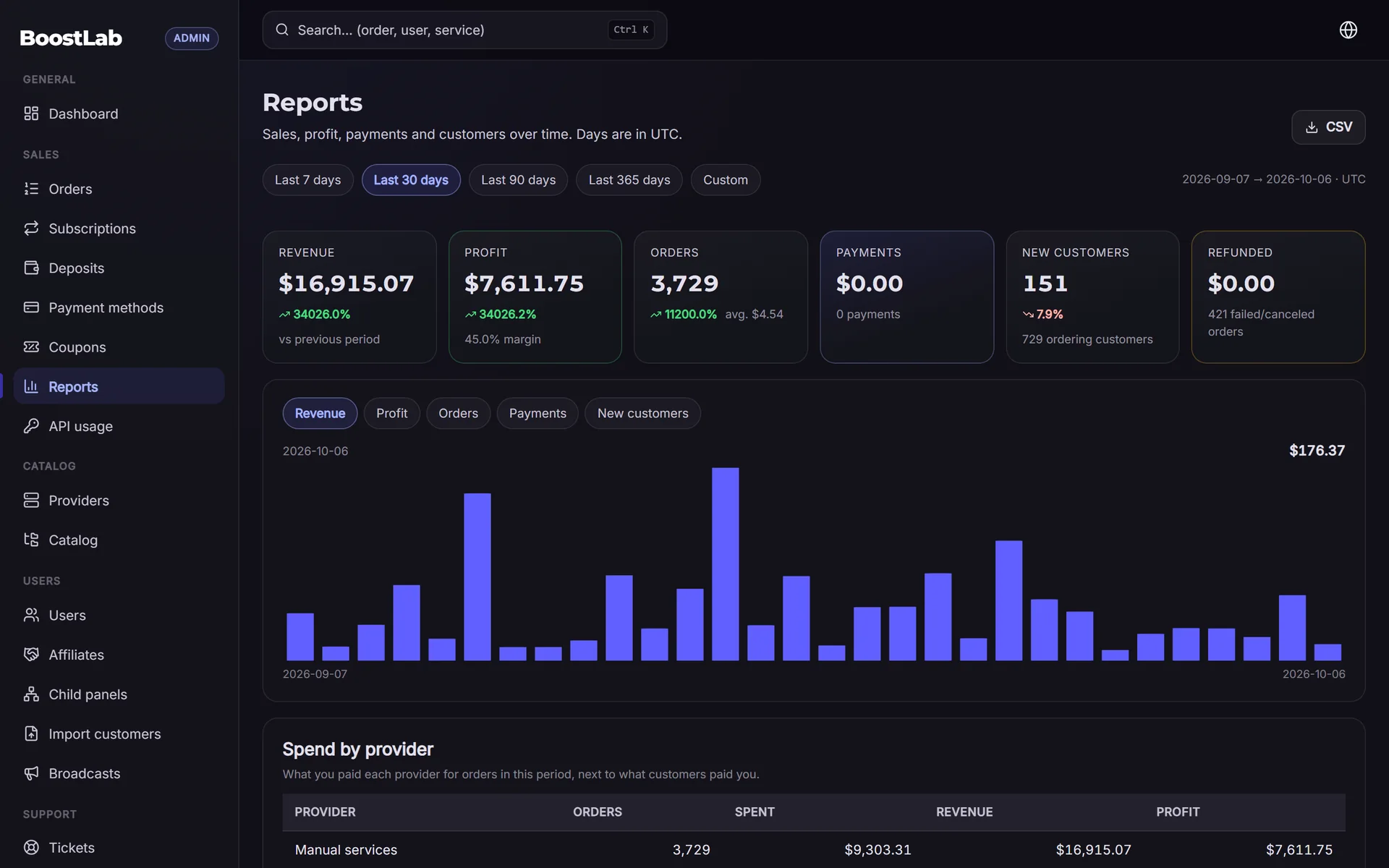
The six core metrics
| Metric | What it measures | How to calculate |
|---|---|---|
| Deposits | Cash coming in | Sum of successful top-ups in the period |
| Active customers | Who actually buys | Customers with at least one order in the period |
| Repeat rate | Loyalty | Share of last month's buyers who bought again this month |
| Average order value | Basket size | Order revenue divided by number of orders |
| Refund rate | Service quality | Refunded amount (full + partial) divided by order revenue |
| Gross margin | Profit per sale | (Order revenue minus provider cost) divided by order revenue |
Deposits and order revenue are not the same thing. Customers deposit first and spend over time, so a panel can show strong deposits while orders lag, or the reverse. Track both, and watch the balance customers are holding: a growing unspent balance is a liability you owe in service.
Reading the numbers together
Single metrics mislead; combinations tell the story. Some common patterns:
- Deposits up, repeat rate down: you are buying or winning new customers but losing them after the first order. Look at service quality and onboarding, not marketing.
- Repeat rate steady, average order falling: customers are still loyal but shifting to cheaper services. Check whether a competitor undercut your best sellers or whether your catalog pushes people toward low-margin items.
- Refund rate rising: a provider is degrading. Find which services drive the refunds and switch or pause them before customers leave.
- Margin shrinking while revenue grows: your bestsellers are your thinnest-margin items, or bonuses and coupons are eating more than you think.
A weekly review routine
- Note the six numbers for the last 7 days next to the previous 7 days.
- List the top 10 services by revenue and check each one's margin and refund rate.
- Look at failed, partial and cancelled orders and group them by provider.
- Check open support tickets: what are people asking about most?
- Pick one thing to fix or test this week. Only one.
Keep a simple log of what you changed and when. Without it you will not know whether a bump in deposits came from a new bonus, a new service or just a lucky week.
For margin maths and pricing rules, see SMM panel pricing and margins and the profit calculator.
Retention: the cheapest growth you will get
A customer who already trusts your panel is far cheaper to keep than a new one is to find. In the SMM business, a large share of revenue usually comes from a smaller group of repeat buyers: agencies, freelancers, resellers and active creators. Your job is to make coming back the default.
Service quality comes first
No coupon fixes slow or dropping orders. Before investing in loyalty tools:
- Remove or hide services with high refund rates, even if they sell well.
- Write honest descriptions: start time, speed, drop expectations, refill window.
- Keep a backup provider for each bestseller so a single provider outage does not stop sales. The services chapter covers this in detail.
- Answer tickets quickly; see customer support.
Coupons
Coupons are best used with a specific purpose, not as a permanent discount:
- Win-back: send a code to customers who have not ordered in 30 days.
- First repeat: a small code after the first completed order, valid for a short time.
- Launch: a code limited to a new service category to get early orders and reviews.
Set an expiry date and usage limits on every coupon. An unlimited public code that leaks to a coupon site becomes a permanent price cut.
Deposit bonuses
A deposit bonus adds a percentage on top of a top-up above a threshold. It brings cash in earlier and locks customers into your panel because the balance lives there. Example tiers (illustrative only):
| Deposit | Bonus | Effective cost of the bonus |
|---|---|---|
| $50+ | 3% | Paid from margin on future orders |
| $200+ | 5% | Same |
| $500+ | 7% | Same |
The bonus is paid out of your margin. If your average gross margin is 30% and you give 7%, you are giving away almost a quarter of your profit on that deposit. Run the numbers before publishing tiers, and avoid bonuses on payment methods with high fees.
Referral program
A referral (affiliate) program pays existing customers a commission on what the people they invite spend. It works well in SMM because many buyers know other buyers: agency teams, Telegram groups, freelancer communities.
- Keep the commission sustainable, typically a small share of the referred customer's spend, paid as panel balance.
- Set a minimum payout so you are not processing tiny amounts.
- Watch for self-referral: the same person creating accounts to earn commission on their own orders.
- Promote the program inside the customer dashboard, not just on a hidden page.
Telegram bot and announcements
Many SMM buyers live in Telegram. A panel Telegram bot lets customers check balances, place orders and track order status without opening the website, and gives you a channel for announcements. SMMFor includes a Telegram bot and a Telegram Mini App.
Use announcements sparingly and usefully:
- New services or categories, with an honest note on speed and quality.
- Price changes on popular services.
- Provider or platform issues that affect delivery ("Instagram likes are slower today").
- Time-limited bonuses — no more than a couple per month, or customers start waiting for them.
The same rules apply to on-site announcements and email. Customers who get an early warning about a slowdown open fewer tickets and stay longer.
Opening a reseller channel
Once you have stable services and fair prices, other panel owners and agencies may want to resell your catalog. This is often where a panel's volume grows the most, because each reseller brings their own customers.
Customer API
Every SMMFor panel exposes a standard SMM API v2 for customers. A reseller adds your panel as a provider in their own panel, and orders flow in automatically. To attract API users:
- Publish a clear API page with the endpoint and a key in the customer dashboard.
- Keep service IDs stable. Changing IDs breaks your resellers' mappings.
- Announce price and status changes before they happen.
Child panels
A child panel is a full panel you sell to a reseller, already connected to your panel as its provider. The reseller gets their own brand and storefront; you get a steady stream of orders. See child panels and the comparison of $1 child panel vs SMM panel.
Pricing for resellers
Resellers need room for their own margin, so they buy on price. Common approaches:
- A lower price tier or custom rates for customers above a monthly spend.
- Visible service quality data (start time, refill window) so they can promise realistic results to their customers.
- Fast responses to API-related tickets — a reseller's outage is your outage.
The full topic is covered in the API and resellers chapter.
Do not undercut your own resellers on your public storefront. If retail prices on your panel are close to reseller rates, they will leave for a provider who protects their margin.
Automation and staff
As order volume grows, the time you spend on manual work grows with it unless you automate. The goal is that you handle exceptions, not routine.
What to automate first
- Order sync, refills and cancels: these run automatically on SMMFor for providers that support them. Make sure every service is mapped to the right provider service.
- Provider failover: keep a backup provider configured for bestsellers so you can switch in one step when a provider fails.
- Automation rules and webhooks: trigger actions on events — for example, notify you on Telegram when a high-value deposit arrives or when failed orders spike.
- Canned replies: prepare answers for the ten most common tickets.
- Admin API: if you have custom reporting or tools, pull data automatically instead of exporting by hand.
When to hire staff
Signs you need help:
- Tickets wait more than a few hours during your active market's daytime.
- You spend more time on support than on catalog and pricing.
- You cannot take a day off without orders going wrong.
Start with a part-time support agent and give them the minimum role they need. Staff accounts with roles let you separate support from finance and settings. The Pro plan includes 3 staff accounts; Business includes unlimited staff. Turn on 2FA for every staff account and review the audit log regularly — the security chapter explains why.
When to upgrade your plan
All SMMFor plans include unlimited orders, services and customers, so you never upgrade just because you are "too big". You upgrade when a feature pays for itself.
| Signal | Plan that fits | Why |
|---|---|---|
| Solo owner, testing the market | Starter ($19/mo) | Core panel, payments and providers |
| You need staff or more designs | Pro ($39/mo) | 3 staff accounts, 18 storefront designs |
| Agency or reseller network, own brand everywhere | Business ($79/mo) | Unlimited staff, all 20 designs, white label, priority support |
A simple rule: if a feature on the next plan saves you more than the price difference in time, or helps keep even one mid-sized customer, the upgrade is worth it. Yearly billing equals 10 months of the monthly price, which helps once you are sure you are staying. Full details are on the pricing page.
If you are moving from another panel script and the migration is holding you back, SMMFor offers migration help.
Expanding to new markets
Growth does not have to mean more of the same customers. Two practical levers:
- Multi-currency display: show prices in your customers' local currency so they do not have to convert mentally. See multi-currency.
- Multi-language storefront and local payments: a Turkish-language storefront with PayTR, Papara or Shopier will convert Turkish buyers far better than an English page with card payments only. Crypto gateways help in markets where cards are hard to use. The payments chapter covers the options.
Add one market at a time, with its own landing content and support hours, and measure it separately.
Growth traps to avoid
These mistakes show up again and again in panels that grow fast and then collapse.
Racing to the lowest price
Cutting prices to beat another panel works for a week. Then they cut back, providers raise costs, and you are left with no margin to cover refunds, bonuses or support. Compete on reliability, clarity and speed of support, and keep a margin floor per service.
Stacking promotions
A coupon on top of a deposit bonus on top of a referral commission can turn a profitable order into a loss. Decide which promotions can combine, and check your margin on the worst-case stack.
Ignoring refunds
A rising refund rate is an early warning that customers are about to leave. Partial refunds look small one by one, but they add up and they cost you customer trust as well as money.
Single-provider dependency
If one provider supplies most of your volume, their outage is your outage, and their price rise is your margin cut. Read how to choose an SMM provider and keep alternatives tested.
Overpromising
Promises like "guaranteed growth", "no drops ever" or "100% safe for your account" cause refunds, disputes and chargebacks. Social platforms' terms may restrict bought engagement, so be honest about what a service does. The legal chapter covers terms and refund policies that protect you.
Growing faster than support
A big promotion that doubles orders while one person answers tickets usually ends with angry customers and chargebacks. Scale support before you scale marketing.
Growth checklist
- Weekly review of deposits, active customers, repeat rate, average order, refund rate and margin.
- Bestsellers have backup providers and honest descriptions.
- Coupons have expiry dates and usage limits.
- Deposit bonus tiers are checked against your average margin.
- Referral program is live and visible in the dashboard.
- Telegram bot connected and announcement rules decided.
- Customer API documented; service IDs stable.
- Automation rules alert you to failed-order spikes and large deposits.
- Staff have minimum roles and 2FA.
- Plan reviewed every quarter against the features you actually need.
Next step
You now have a framework for growing a panel without losing control of margins or quality. Keep the SMM panel glossary handy for any term you are unsure of, and check the FAQ for quick answers.
If you have not opened your panel yet, you can start an SMM panel on SMMFor. The current offer is a 3-day free trial, then $1 for the first month on any plan; see pricing for details.